During colonial Virginia’s 1640s real estate land rush, the first official English settlers arrived in Lancaster County and, what would become Middlesex County, armed with markers, pads and broad axes to record and mark their land grant property lines.
They paddled and poled along creeks and coves looking for prime real estate for the building of a home and good land to grow tobacco. A signature of attractive waterfront property then was when there were mounds of oyster shells jutting out of the water near the shore.
For generations, Native Americans roasted oysters for sustenance and disposed of shells by tossing them onto mounded shell piles in the water. As an afterthought, settlers were looking for waterfront property where oysters flourished close to shore; but their main search was for land already cleared by Native Americans for agriculture. The mounded in-water oyster piles were a sign the land had been used as a village or home of Native Americans. The elimination of the laborious task of removing trees and forest to grow tobacco was an attractive feature to those early settlers.
Once settlers established their boundaries, built their homes and started living there, the oyster became a vital part in the lives of Tidewater Virginians. The bivalve provided a nature grown food source for colonists just a short walk from their homes and the oyster would later go on to become an economic force in the area’s economy.
Northern oystermen
Through the late 1600s and well into the 1700s, Virginia developed a cottage industry around oysters. As the population moved inland resulting in some Virginians having less access to the water and oysters, a cottage industry evolved. Oystermen tonged oysters and sold oysters-in-the-shell to neighbors and friends not so inclined or able to go out and harvest their own.
The market expanded as the customer base grew with people wanting shucked raw meat ready to drop into a frying pan or an oyster stew pot. To meet that demand, oystermen built small buildings onto their property to shuck oysters out of the weather and where customers could come to buy.
As demand for oysters grew beyond the neighborhoods as transportation and refrigeration improved, oystermen hired other oystermen as shuckers and expanded the size of their oyster houses to increase production.
This cottage industry was already well established when in the late 1700s New York, New Jersey and Connecticut oyster boats arrived on the Chesapeake to beg, borrow and steal oysters to meet an enormous supply and demand in New York City and elsewhere in the north.
By then, Northern oyster growers had long ago passed the cottage industry stage and the large population in the north had depleted oysters on natural beds in their rivers and were unable to privately grow oysters fast enough to meet demand.
The Yanks introduced Chesapeake Bay oystermen to the national market scene and within a decade or two large oyster shucking houses in Virginia and Maryland were built on the bay to meet increasing national demand for shucked Chesapeake Bay oysters.
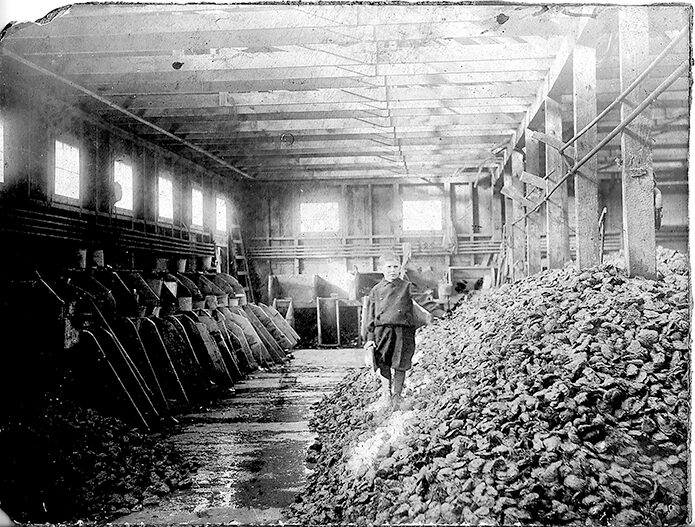
J.W. Hurley & Son Seafood 1890s-1950s
In waterfront towns and at steamboat landings, particularly those on the Rappahannock River where superb market size oysters grow, shucking houses sprang up. Small two and three-man shucking houses were scattered on most every creek and stream up to freshet lines in the rivers where oysters stop growing.
The industry started well before the Civil War, but in the aftermath of the war, oysters provided sustenance and a major boost to the local economy. While many areas in Virginia suffered the economic depression associated with the South losing the war, the oyster industry helped Tidewater Virginia rebound economically.
The Town of Urbanna had one of the largest oyster shucking houses in the region, J.W. Hurley & Son Seafood. Hurley was from Hurlock, Maryland. He discovered Urbanna and Rappahannock River while buying oysters for an Eastern Shore of Maryland oyster company. He liked the area, moved here and established a shucking house and seafood business at the foot of Virginia Street in town. His brand “King of Them All Famous Rappahannock River Oysters” became known nationwide.
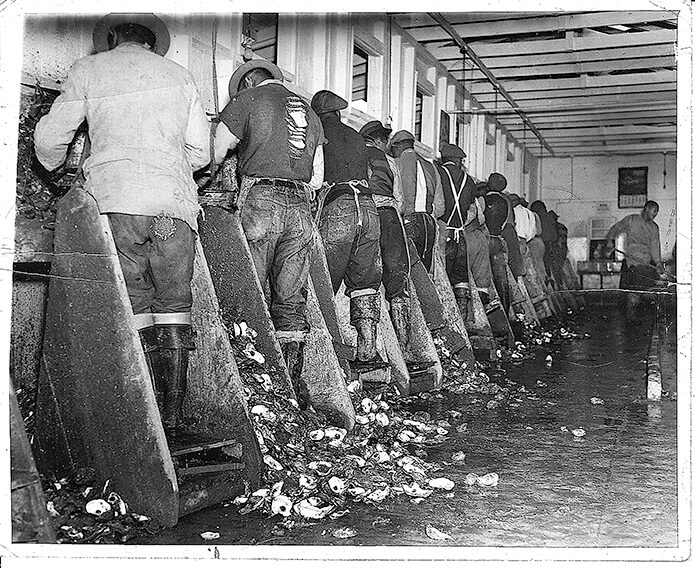
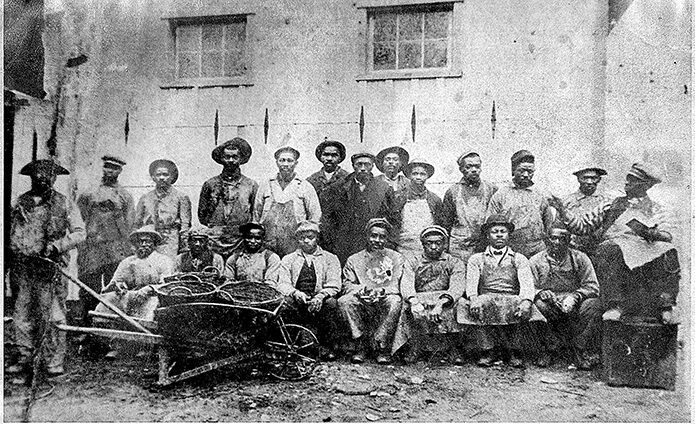
During the oyster season, African-American shuckers came to Urbanna from surrounding counties to work at Hurley’s and at other shucking houses. Hurley’s employed between 50 to 100 shuckers to shuck between 300 and 400 bushels of “shucking stock” daily. To accommodate housing for shuckers, a boarding facility called the “Long House” was built on the shoreline. African-Americans lived in the Long House and worked six days a week.
In a 1985 Southside Sentinel interview with a Hurley employee, the late Woodland Rowe of Urbanna, he spoke of a day in the life at the shucking house. “When I came to Hurley’s (in the late 1920s) there were about 50 to 60 shuckers working, but I was told that in the early days (1890s) there were as many as a hundred shuckers. Most of them were Black males, but later on we had more Black female shuckers. I loved the sounds of the shuckers. They would hum and sing as they worked. Some of them could really sing too, boy. I was a good Methodist and attended Urbanna Methodist Church. We had a great choir, but I have to admit that shucking house choir was better.
“They would start work around 6 a.m. and leave at 5 p.m. During breakfast and lunch, they gathered around the pot-bellied woodstove, ate sandwiches and canned sardines and told jokes to one another. They shucked oysters into a galvanized bucket. When full, the bucket was emptied and a tally was kept of each full bucket from each individual shucker. Shuckers were paid by the number of gallons shucked in a day. The shucked oysters were taken to a skimming room where the raw meat was cleaned of shell and grit, and measured to determine the shuckers’ wages. While I was there shuckers were paid between 30 and 35 cents a gallon. Oysters were packaged for market in five-, 10- and 15-gallon containers, sealed and covered with ice” he said.
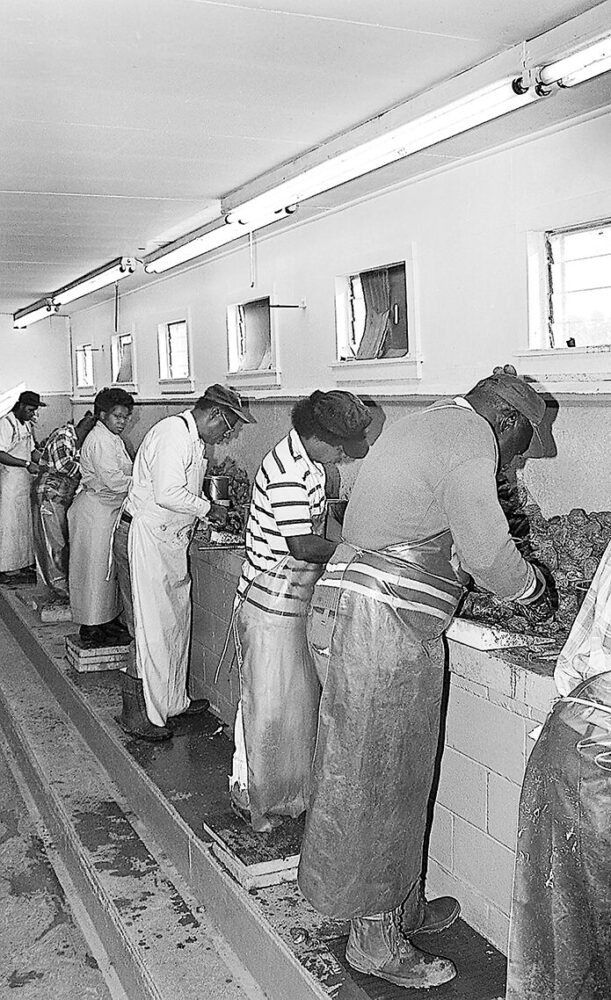
“Part of my job was to be the maintenance man. In those days, shuckers worked in wooden shucking stalls (called boxes by some), and I made every one of them. We had standard size stalls, but I even made custom stalls. When Mason Carter got old, Mr. Hurley told me to make him a box (stall) he could step into and a board fit across it for a seat.”
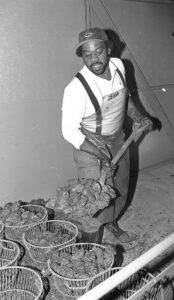
There were also day men, or shell wheelers, hired to clean up and keep shuckers in oysters. “They were hired and paid by the hour. Oysters were handled in bushel oak-splint or wicker baskets. Later, Boyd Hurley got wire baskets. I was told oak-splint bushel baskets were brought here by Yankee oystermen,” said Rowe. “The wicker baskets were purchased from Baltimore and delivered by steamboat at Burton’s (steamboat) Wharf.”
The Hurleys sold most of their oysters to O.E. Wentworth Co. in Baltimore. Hurley oysters were shipped to Baltimore six days a week by steamboat. On Monday, Tuesday, Thursday and Friday they were shipped from Burton’s (steamboat) Wharf at the foot of Watling Street.
On Wednesdays, Rowe trucked iced-down oysters to West Urbanna (steamboat) Wharf at the end of Lord Mott Road. “Wednesday was the only day the side-wheeler (steamboat) Middlesex came in the river,” said Rowe. “It always went to West Urbanna Wharf because it was too big to turn around in Urbanna Creek.” On other days, the smaller (prop driven) steamers came into the creek landings to pick up Hurley’s product.
“Steamboats did not run on the Rappahannock on Saturdays, so I hauled oysters to West Point on York River in a snub-nose International truck to catch the steamboat there bound for Baltimore. Sometimes I’d be a half-day driving to West Point. There weren’t many good roads back then,” said Rowe.
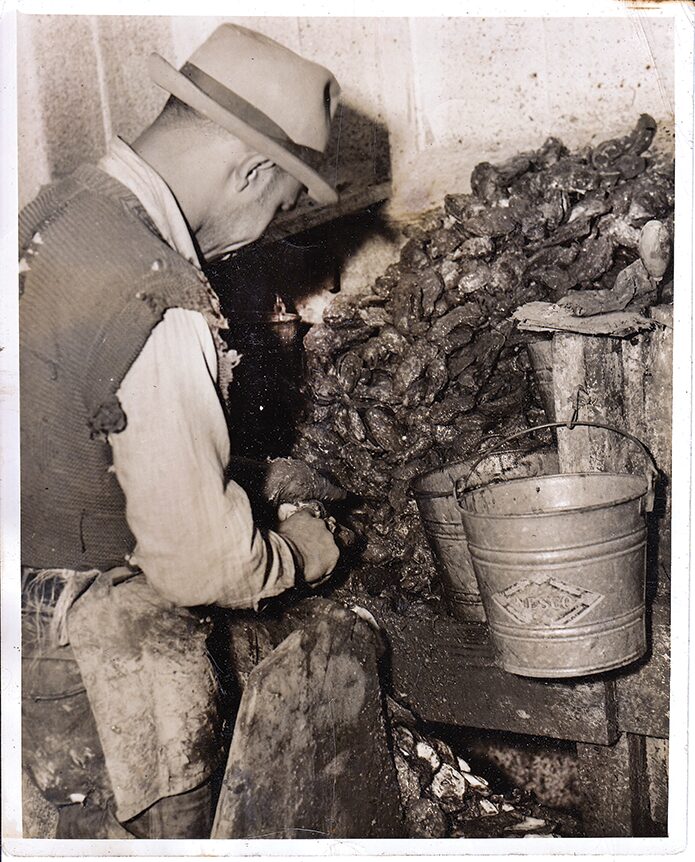
Large area shucking houses were scattered along both sides of the Rappahannock into the 1960s and 1970s when the oyster disease MSX and dermo brought the natural strikes almost to a halt — all of the large shucking houses shut down.
Virginia and Maryland efforts to bring back the oyster by developing disease-resistant oysters and developing aquaculture methods tremendously aided in revival of the oyster fishery. The ancient craft of opening oysters can still be found inside the small roadside oyster houses on the Northern Neck and Middle Peninsula.
Sarah Hammond Stokes — oyster shucker
The Urbanna Oyster Festival Foundation has named oyster shucker Sarah Hammond Stokes, 86, of Urbanna as the 2025 oyster festival captain.
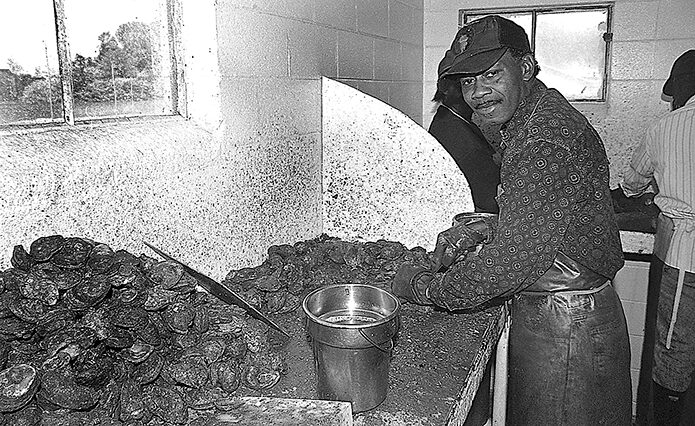
A Middlesex native, Stokes surprised a field of women oyster shuckers in 1983 at the Virginia Oyster Shucking Contest in Urbanna by winning the female championship and earning a trip to St. Mary’s County, Md., to compete in the National Oyster Shucking Championship.
She also surprised everyone at the national championship at St. Mary’s by winning the women’s championship and then captured the overall (men/women) competition, both times with the slowest times but with the cleanest shucks.
During the contest, each shucker is allowed to select 24 oysters for each heat. The object is to shuck them as fast as possible and arrange them on the half-shell as attractively and with as little damage to each individual oyster as possible. Stokes had the magic touch with her arrangements and had the most clean/undamaged shucked oysters of all.
With her win at the national contest, she won an all-expense paid trip to Galway, Ireland, to compete in the 1984 International Oyster Shucking Contest. Nine countries competed in the international event and Stokes finished third in the competition.
“It was one of the greatest experiences of my life,” said Stokes who lives in Urbanna. “I was so proud when the three finishers in Galway got to stand on the stage with the flag of their country. They gave me an American flag to hold. It was one of my proudest moments.”
Stokes was the trailblazer for other Virginia women shuckers such as Deborah Pratt, a three-time national champion and a second place finisher in 1997 and third place in 1994 at the International Oyster Shucking Contest in Galway.
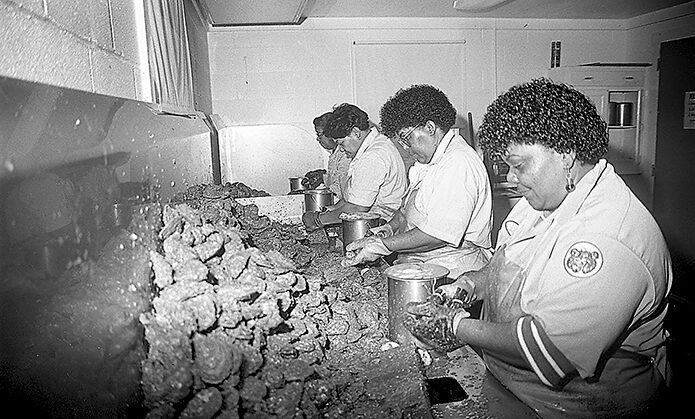
Stokes history
Stokes grew up in the Revis area of Middlesex and her first job was as a field hand picking tomatoes and vegetables for the Crittendens and other farms in the county. She picked vegetables in the spring and worked in a Remlik crab picking house during warmer weather months.
About 1960, her friend Georgia Foster asked her if she would fill in for her at Ferguson’s Seafood oyster shucking house. She needed a day off. Stokes went to work that day and before the day was over foreman Jasper Bray told her, he had a “box” shucking stall for her anytime she wanted it.
“I think working in the shucking house was some of the happiest days of my life,” she said. “There were about 40 women and men shuckers at Ferguson’s then and we all got along good.”
The Remlik shucking house was one of the largest in Virginia. “I was never the fastest shucker, but I always shucked a real clean oyster. I had very few cuts on the meat,” she said.
The fastest oyster shucker Stokes said she ever saw was George “Pee-Wee” Hodges. “The first day I went to the shucking house Pee-Wee came over and gave me some tips. I’ve never seen anyone shuck an oyster faster than Pee-Wee, but I think mine were cleaner.
“I worked in shucking houses as long as I was able,” she said. When Stokes competed in the 1983 Virginia Oyster Shucking Contest she was sponsored by Elmo Marshall, who owned C.E. Marshall Seafood Inc. in Church View.
“We are delighted to have Sarah as our 2025 Urbanna Oyster Festival Captain,” said festival chairman Joe Heyman. “We hold this festival every year as a reminder of the amazing role that the oyster industry played in the history, culture and economic growth of our area. Sarah is a tribute to that culture!”