


Few have heard of Queenstown, but this lost settlement that existed on Corrotoman Creek in Lancaster County was once an important port for trade and tax collection. The Act of Ports was created by the General Assembly and stated that every county would be required to purchase and build a port town for the purpose of simplifying and streamlining the shipping and taxing processes. Before the creation of these ports, shipping was often disorganized and standards differed among areas. As a result, the government was unncessisarily losing revenue.
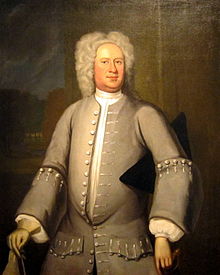
In 1692 Lancaster County began construction of Queenstown. Prominent citizens Robert “King” Carter and Captain David Fox were appointed to oversee the project. The two gentlemen found and acquired the 50 acre parcel on from Captain William Ball in exchange for 13,000 pounds of tobacco. The land was divided into lots and sold to individuals for building. Land was also set aside for the construction of a church, courthouse, market place, prison, and road system.
Carter, a prominent and wealthy businessman, was reportedly paid 45,000 pounds of tobacco to oversee the construction of a county courthouse and prison.
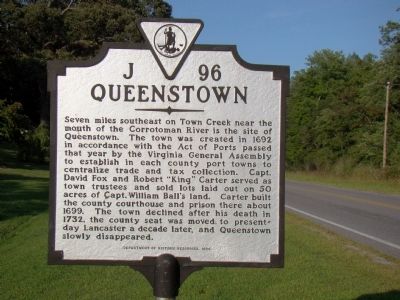
A historical marker has been placed at the intersection of Mary White Chapel Road (Virginia Route 201) and River Road (U.S. 354) in commemoration of Queenstown.
The marker reads:
Seven miles southeast on Town Creek near the mouth of the Corrotoman River is the site of Queenstown. The town was created in 1692 in accordance with the Act of Ports passed that year by the Virginia General Assembly to establish in each county port towns to centralize trade and, tax collection. Capt. David Fox and Robert “King” Carter served as town trustees and sold lots laid out on 50 acres of Capt.William Ball’s land. Carter built the county courthouse and prison there about 1699. The town declined after his death in 1732, the county seat was moved to present- day Lancaster a decade later, and Queenstown slowly disappeared.
Unlike many other Virginia port towns (such as West Point, Tappahannock, and Norfolk) Queenstown did not flourish and, instead, declined after Carter’s death. The particular reasons for its downfall are unknown but could possibly be attributed to the fact that the creek was not ideal for navigation.
Information courtesy of the Northern Neck Historical Society