


In 1866 congress ordered the creation of several peacetime regiments made-up entirely of African American Soldiers. These brave men were given the nickname “Buffalo Soldiers” by the Native American tribes they encountered. It is unclear exactly why this nickname was chosen. Some believe it was based on the physical appearance of the soldiers. Others suspect that the nickname was based on their fierce and brave battle tactics. Either way, the soldiers took it as a compliment as the buffalo was a highly revered animal in native culture.
The main task of these soldiers was to protect the settlers and their communities and to aid in westward expansion.
The Buffalo Soldiers were primarily stationed in the western part of the country and in the Great Plains. A few Buffalo Soldiers have actually been traced to Westmoreland County in the Northern Neck.
One of these soldiers was Walter Tate. Tate was born in Zacata in 1854 and in 1879 he traveled west to Texas, where he joined the 10th Cavalry Regiment. He fought valiantly as a Buffalo Soldier for 5 years before he was wounded 1884.
He then returned home to Westmoreland where he took up farming and raised a family. He has many proud descendants who still call the area home.
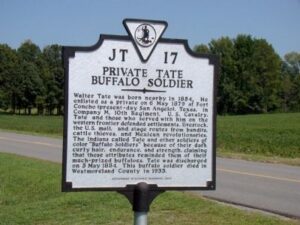
On Zacata Road in Westmoreland County, there stands a historical marker in honor of Private Walter Tate. It reads:
“Walter Tate was born nearby in 1854. He enlisted as a Private on 6 May 1879 at Fort Concho (present-day San Angelo), Texas, in Company M, 10th Regiment, U.S. Cavalry. Tate and those who served with him on the western frontier defended settlements, livestock, the U.S. mail, and stage routes from bandits, cattle thieves, and Mexican revolutionaries. The Indians called Tate and other soldiers of color “Buffalo Soldiers” because of their dark curly hair, endurance, and strength, claiming that these attributes reminded them of their much-prized buffaloes. Tate was discharged on 5 May 1884. This buffalo soldier died in Westmoreland County in 1933.”