

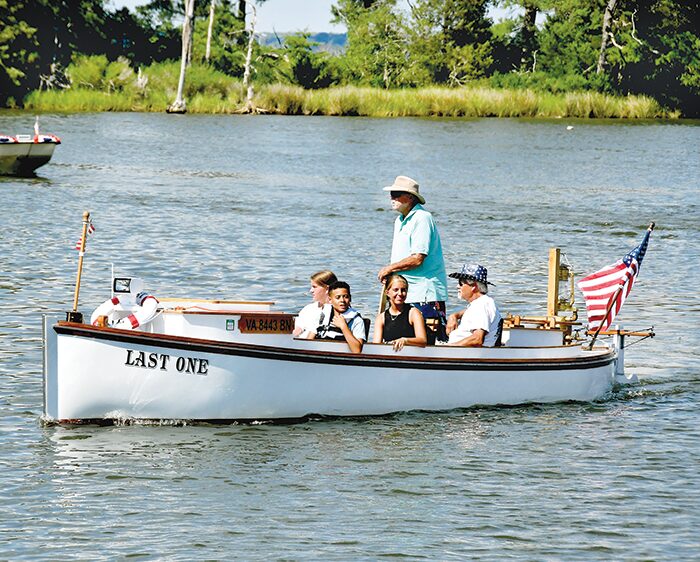
One of the more unusual boats at the “Rivah” is a “log canoe” scheduled to be in the Urbanna Boat Parade on July 5 at 6 p.m.
The hull of Last One was made from three huge logs that were joined together and hewn into a graceful smooth shape by the late Charlie Dunlevy of Topping, who didn’t live to complete it. (See related story on page 74.)
Finishing this log hull boat fell to Tommy Daniels of Gwynn’s Island in Mathews, who bought the hull in 2022.
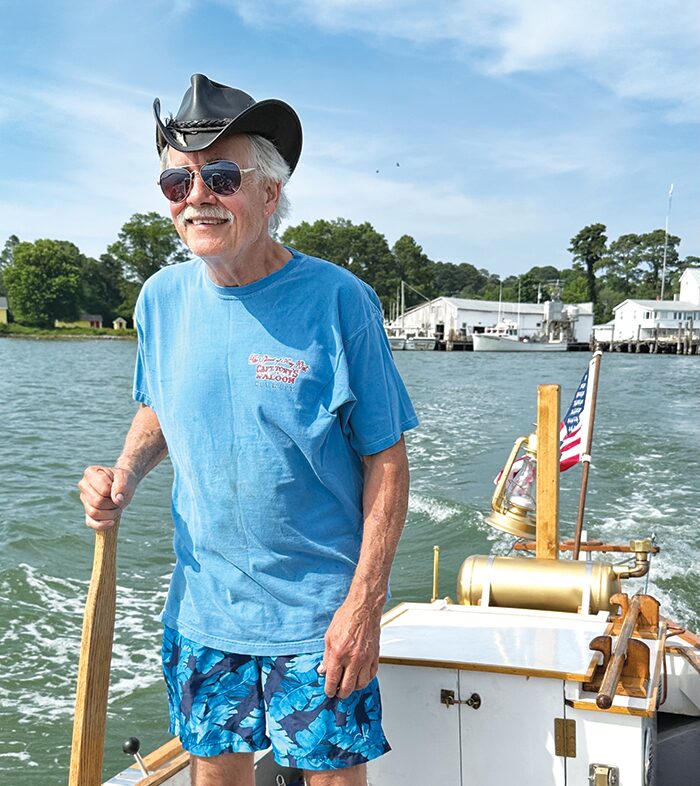
Daniels went to great lengths to make Last One an authentic replica of a 100-year-old log canoe and completed a unique boat, while preserving the legacy of Charlie Dunlevy’s masterpiece. “It’s an honor to work on it,” Daniels said, following a sea trial testing the three cylinder Yanmar diesel he had just installed. “I tried to keep the boat’s quality and craftsmanship that Charlie Dunlevy put into it. It’s as solid as a rock. I’m just the caretaker for whoever gets it after me.”
Finishing touches
Daniels said he’s touched every part of Last One — and his thoughtful approach to details is evident. He used his lathe to machine solid brass into pulleys for the steering cables of the “Guinea Stick” used to steer. He strengthened the rudder.
Daniels installed a small diesel engine with 30-horsepower, good enough to push the 15-foot boat 9 miles per hour.
It took Daniels 14 hours to weld stainless steel to make the thrust bearing, a critical part that holds the driveshaft at the propeller.
Five individual seats that hook to the floor were fashioned. The backs fold down to make a table. And they can be removed and used on the beach!
From a large copper cylinder Daniels made a fuel tank, complete with a see-through fuel level gauge attached to the side.
The stern light is a kerosene brass lantern, converted to electric.
He installed a brass switch that came from the actual U.S. Coast Guard Cutter “Tamaroa” that rescued a helicopter crew that ditched in the Atlantic attempting a rescue during the actual “Perfect Storm” in 1991.
Heritage
Daniels said he approached the project with an open mind, letting the boat dictate what could or couldn’t be done. “I followed in the footsteps of a giant,” said Daniels referring to Dunlevy, who built the log hull. “I appreciate his craftsmanship. Craftsmanship like this is disappearing . . . when it’s gone, it will take ‘AI’ to replace what craftsmen did.”
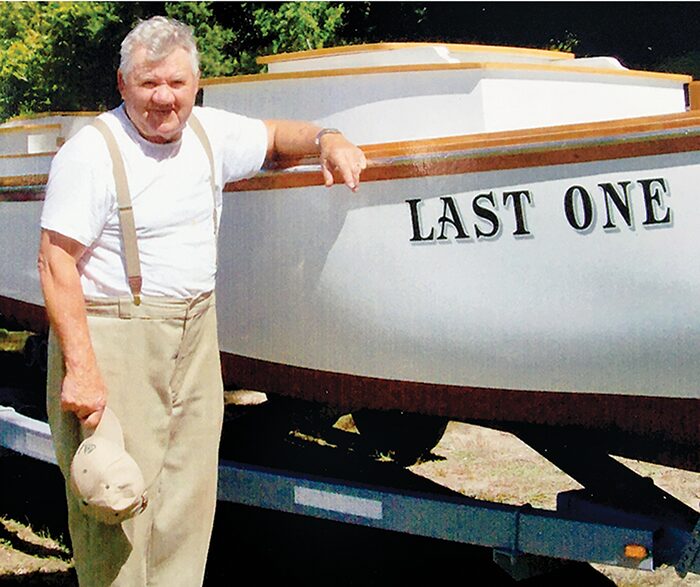
The heritage of log canoes goes back to Native Americans who hollowed out large logs by selectively burning areas of the logs to make canoes. Settlers figured how to attach a half log to each side for a wider more stable vessel. A sail was rigged and these swift boats carried watermen to oyster grounds, and other places when water was still the most efficient way to travel.
Not the first
Daniels, 75, has a gift for figuring out machines and fabrication. He was part of a local team that set a land speed record at the Bonneville Salt Flats a few years ago. They took a four-cylinder Ford engine from the 1930s, replaced the flathead with a modern General Motor’s head, and ran the hot rod 166 miles per hour for a record that still stands.
Daniels is a five-time national champion with the American Racing Lawn Mower Association. He just finished a street rod powered by a Kawasaki Ninja motorcycle engine. On the slower side, he has a 100-year-old hit-and-miss engine that he takes to shows.
See it
You can get a close up look at Last One at Wings, Wheels & Keels on Sept. 27 at Hummel Field airport in Topping, when this one-of-a-kind boat returns home for the day.
From woods to the water, a legacy hewn from logs: A boat from a by-gone era
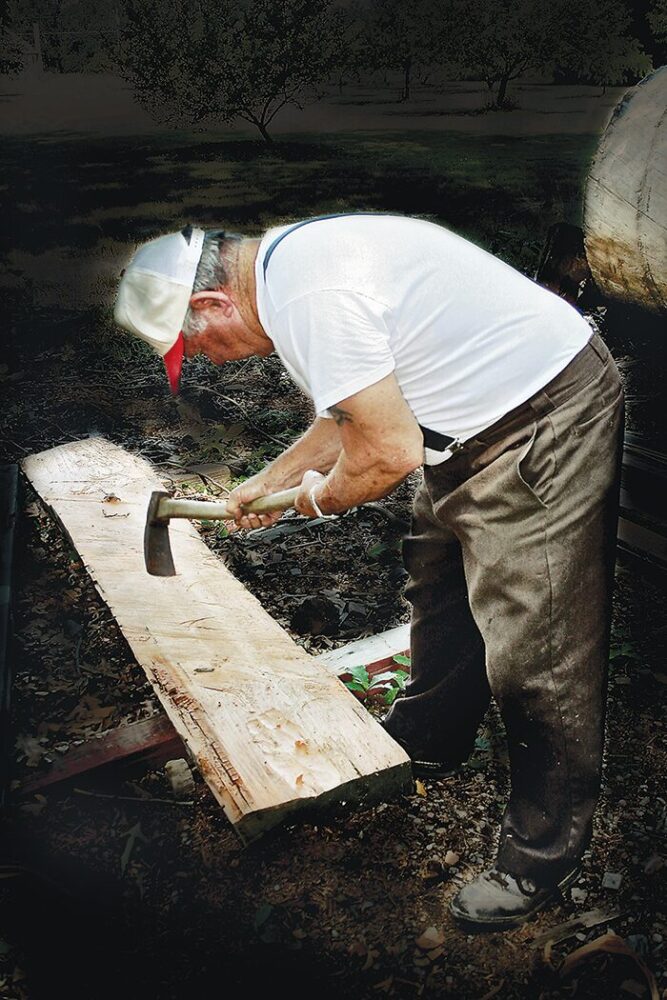
Charlie Dunlevy’s roots were in and around the water. Born in 1936, he grew up watching relatives build boats in Deltaville in the 1940s and 1950s. Building his log canoe Last One was the culmination of a dream that simmered for 20-plus years.
Following World War II, like many, Charlie gave up on book learning and got a job. “Work” was not a four-letter word to Charlie, who worked bridge and tunnel construction from Norfolk to Boston.
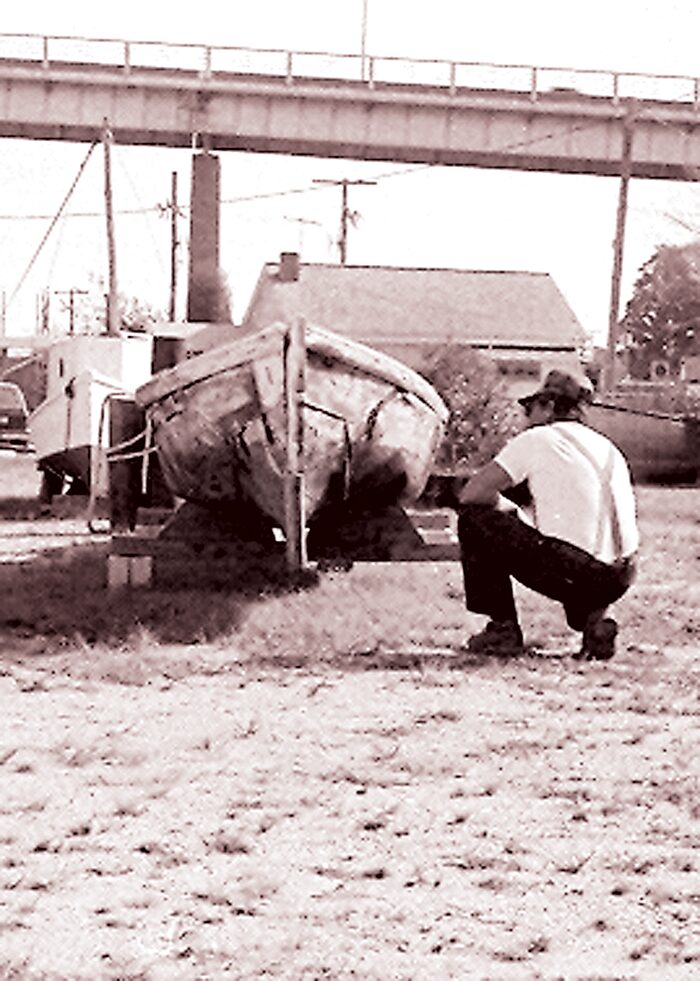
On a warm day in 1985, Charlie and his son Charles Jr. “Bunny” were near Yorktown and Charlie was talking about his time oystering the York River and mentioned log canoes. “I told him I knew where a log canoe was and he thought I was joking with him.” They drove down to the Watermen’s Museum on the Yorktown waterfront. There on the beach was a decaying log canoe. It was the first one he’d seen in 40 years.
As Charlie studied its lines, a dream hatched. “He never stopped working towards building a log canoe from that day,” recalled Bunny, of Remlik.
Two decades later, Charlie, who had built other boats, began creating what would be his legacy. His log canoe, aptly named Last One started in the woods. Standing trees were ready-made posts for his lift. “Pop used cable jacks, ropes, and his smarts to do every bit of the work by himself,” said Bunny.
Huge logs
The huge logs that would make up the hull were anywhere from 3 feet to 4.5 feet in diameter and 12 feet long. They had been used as “fenders” to keep long tunnel sections from rubbing against each other as they are floated into place to build a tunnel serving Logan Airport in Boston.
Charlie used an ancient type of ax called an “adz” to shape the logs. It resembles a gardening hoe but its sharp blade is used to trim and shape timbers. The “foot adz” is also known as a shipbuilder’s or carpenter’s adz. He also was keen with a bandsaw.
Before sawmills became prevalent, logs were easier to find than sawn lumber. The logs were joined together and held in place by large wooden dowels. For extra strength, Charlie also glued them with epoxy.
Charlie knew a wooden boat would not last long without constant maintenance. So he covered Last One’s hull in fiberglass.
Charlie worked on Last One about five years, before he laid down his tools for the last time in 2013 at age 77.
Next chapter
The torch was passed to Tommy Daniels of Mathews who bought Charlie’s hull. It took him two years to complete the boat. “I followed in the footsteps of a giant,” said Daniels referring to Charlie Dunlevy. “I appreciate his craftsmanship. Craftsmanship like this is disappearing . . . when it’s gone artificial intelligence will build things, but they won’t be built like this.”
The boat and the builder are both the “Last One.”
See this remarkable boat in the Urbanna Boat Parade on July 5 at 6 p.m. And stay for the lighted drone show. It also will be at Wings, Wheels & Keels on Sept. 27 at Hummel Field airport in Topping.