

 (Note to readers: This column of “It Happened Here” originally ran in the August 2015 Rivah. With recent news that St. Margaret’s School for girls in Tappahannock will not be opening in the fall due to finances, it seems only appropriate to revisit some of its history.)
Stingarees is a mid-19th century alteration of the word stingray. At least until 1933 the nickname of the Christchurch School mascot was stingarees — not seahorses as it is today.
 In a Feb. 8, 1989 article in the Southside Sentinel, the late Lewis Pierce of Urbanna said that in 1933, the year he graduated from Christchurch, students there referred to themselves as “stingarees.” He displayed with pride a brass belt buckle embossed with the name Christchurch and an image of a stingray beneath the school name.
Christchurch School in Middlesex County was founded in 1921 as an all-boys school by the Diocese of Virginia along with several other schools in the state, including St. Christopher’s and St. Catherine’s in Richmond, St. Margaret’s School in Tappahannock, and St. Anne’s School in Charlottesville.
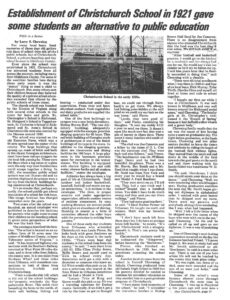
In 1920, the Rev. F. Ernest Warren was the Episcopal minister at Christ Church Parish (Episcopal) in Middlesex County and he spearheaded a campaign to have a church school located near Urbanna. Warren was also secretary of the Urbanna Board of Trade, a progressive group of businessmen. Warren gained their support and persuaded them to donate $4,200 to go towards purchasing the property for the school.
Early in the process, an Episcopal school advisory committee advised diocesan trustees on where best to locate all-girls and all-boys schools in the Tidewater region. On Oct. 14, 1920, the Diocese Advisory Committee recommended the boys school be located at Warsaw, but was split on the best location for an all-girls school. A majority wanted it located in Tappahannock, but Warren had gathered strong support for the all-girls school being located near Urbanna.
Warren’s argument for a girls school in Urbanna was that the town offered good transportation (steamboats) and a reasonable cost for excellent foods “in the heart of the Rappahannock oyster and fish industry.” He additionally spoke of artesian water, freedom from typhoid and malaria, the strong moral tone of the town, the active Business Men’s Association, the guests who come each year from “Baltimore, Philadelphia and New York as well as from Richmond,” the government concrete road (from West Point to Saluda) and availability of good sites for a school. He was also able to secure financial pledges of $15,000. The actual startup cost for 50 students was $35,000.
The site for a school was further complicated when the Fredericksburg Chamber of Commerce approached the diocesan trustees about having a school located there and they suggested an attractive site in downtown Fredericksburg. At this junction, the trustees decided to form a new school location committee, composed of members outside of the Tidewater region.
The new committee recommended the girls school, St. Margaret’s, site as Tappahannock and the boys school in Fredericksburg, rather than Warsaw. The committee recommended a second boys school be near Urbanna when and if funds were available.
The day before the diocesan trustees met to vote on the matter the land in Fredericksburg for a proposed school site was sold to someone else, leaving Urbanna as the top choice. The trustees voted unanimously to build St. Margaret’s in Tappahannock, and on a 9-4 vote to build Christchurch near Urbanna.
Although the Urbanna Board of Trade recommended the school be located at Malvern Hill, just west of town, they agreed to donate $4,200 to help purchase the property where the school now sits. The Board of Trade wrote in their minutes that “the school will have a strong economic and social impact on our town and county for generations to come.”
It Happened Here in Rivah Country!