

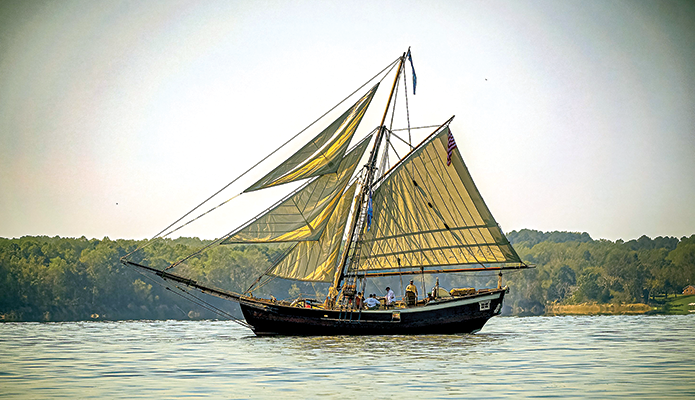
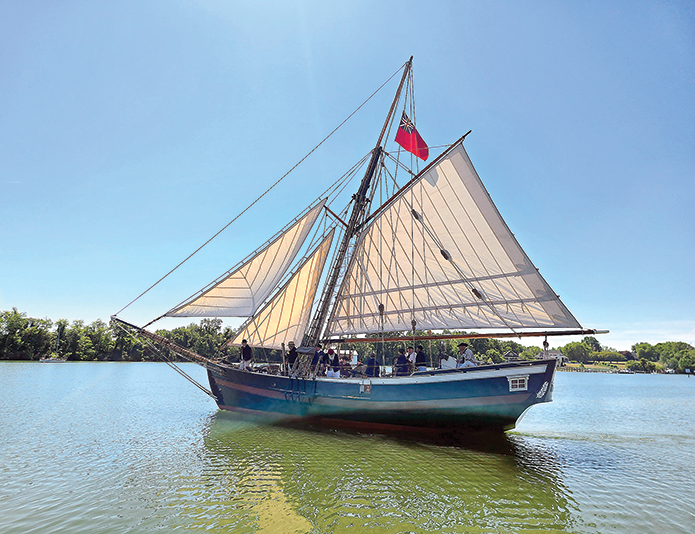
When the Colonial Seaport Foundation took on the challenge of building Luna, a 1768 replica of a Virginia sloop. Founder and president Jock Collamore had no idea that the America 250 celebrations would lead to Luna’s decks becoming center stage to documentary/movie productions.
Luna was recently center stage in the documentary on the “Battle of Hampton,” replicating the history when the Liberty, a Royal Navy tender, was blown aground near Hampton during a hurricane in September 1775. The Liberty was then seized and set on fire by local patriots.
British captain Matthew Squire of the HMS Otter blockaded Hampton Harbor in 1775 and demanded the return of the Crown’s property and in response Hampton residents refused and demanded the return of an enslaved person, Joseph Harris, and other enslaved individuals. The group fled to freedom aboard the British fleet.
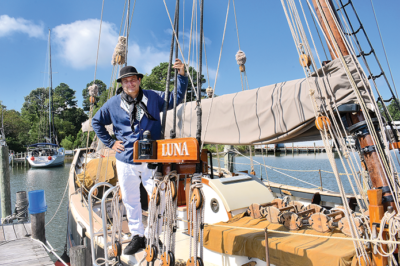
On Oct. 26, 1775, Captain Squire bombarded and burned the town. Part of the movie was filmed on Urbanna Creek at the Urbanna Town Marina. Luna, portraying the British HMS Otter, was docked at Urbanna Town Marina from Monday to Wednesday, May 11 through 13, when the filming took place.
The movie “Journey of Liberty” is a 30-minute documentary film by Seltzer Film and Video for the Hampton History Museum. It speaks to those revolutionary historical events that occurred at Hampton on Oct. 26-27, 1775.
The movie featured professional actors and had local reenactors for crew, said Collamore. “The Luna has become center stage for many of the local America 250 events,” said Collamore. “They used professional actors in the documentary, but we have our crew dressed in period clothing as they run the boat.
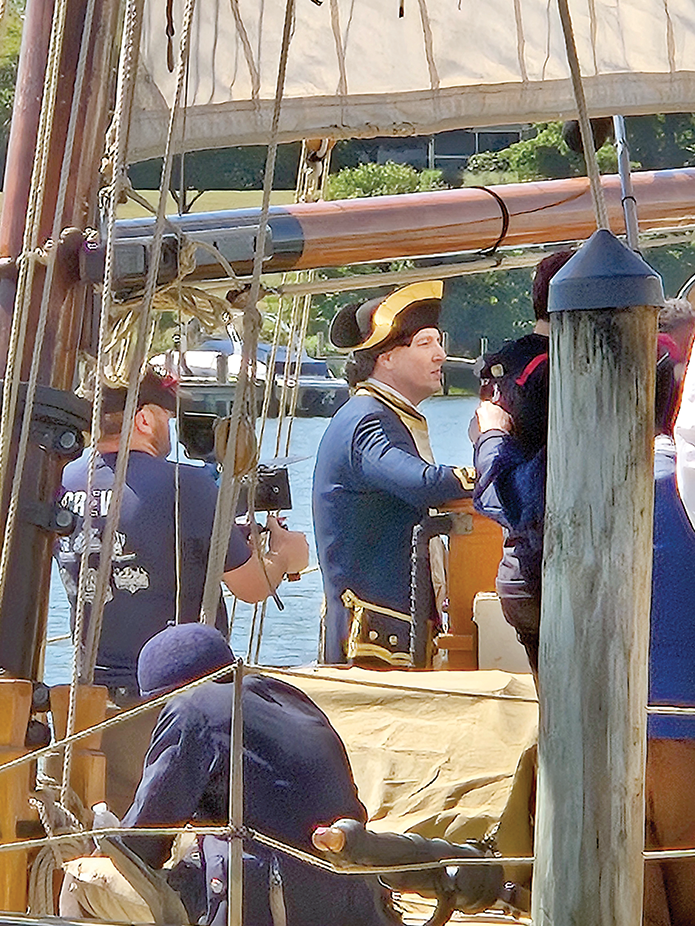
“I had no idea that the Luna would be in so much demand over this America 250 celebration,” he said. “It does make sense in that we are the only show in town.” Luna is one of just a few replicas of revolutionary war period sloops in the United States and can be used as both an English and American vessel. “All we have to do is change flags and change our attire a bit and we can be British or American,” said Collamore.
“It started with the Yorktown celebration in 2024 of the 250th anniversary of the Yorktown tea party,” he said. “They wanted a replica of a Revolutionary War period vessel to stage the tea party.”
On Nov. 7, 1774, local residents of Yorktown, led by patriot Thomas Nelson Jr., boarded the British ship Virginia and dumped two half chests of tea into the York River. The tea had been sent from London for Williamsburg merchant John Prentis, who defied the first Virginia Revolutionary Convention demand that had banned importing of English goods and tea in August 1774.
Collamore and Luna were also involved in a local production of the “Battle of Cricket Hill” in Mathews County, where he provided some common sense advice to the actors. “When we were under way, I told the reenactors not to stand at attention and to walk on the deck like a sailor or you might fall overboard,” he said.
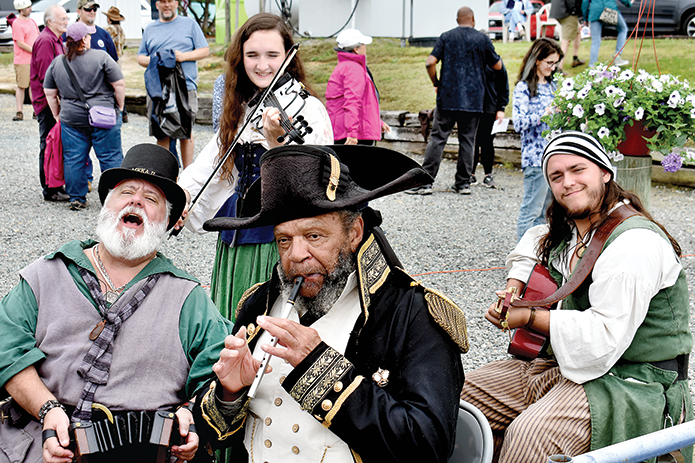
The Battle of Cricket Hill, also known as the Battle of Gwynn’s Island, was an early American Revolutionary War engagement on July 9, 1776, just days after the signing of the Declaration of Independence. Commanded by General Andrew Lewis, Virginia patriot forces shelled Lord Dunmore’s entrenched royal fleet and camp across the narrow channel from Mathews County, permanently driving the last royal governor of Virginia from the colony.
“This area was truly a hotbed of independence,” said Collamore. “The American 250 celebration has brought work to many dedicated reenactors who find joy in bringing history alive. That was part of our mission when we started the Luna project in 2007 but I had no idea that it would bring the amount of work to us through celebrations and documentary stints. We literally have historical booking events into 2031.
“When the Battle of Hampton was filmed, as a reenactor I provided guidance and understanding at the filming and how I think things would have been aboard the Otter in 1776,” said Collamore.
“We did two sets of maneuvers in Urbanna Creek for the film,” he said. “We did a film set while the engine was running and a set under sail so they could do sound work with the engine off.
“We had two cannon firing shots in the movie and that was done out in the middle of the Rappahannock River, and it was handled by our volunteer crew of reenactors.”
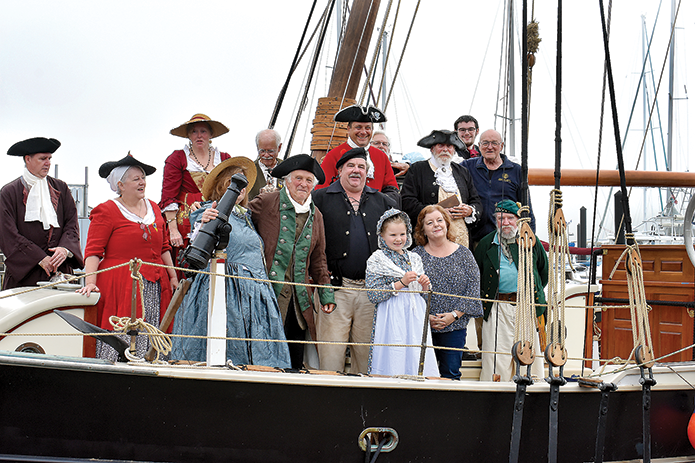
Collamore thanked the many reenactor volunteers who faithfully took part in the Luna experience.
He also said that his location on the bay is one of the best as Deltaville provides the boatbuilding infrastructure to help keep Luna shipshape and he is not far away from the Colonial seaport town of Urbanna, whose history is strongly tied to early English settlement and the Revolutionary War period.