


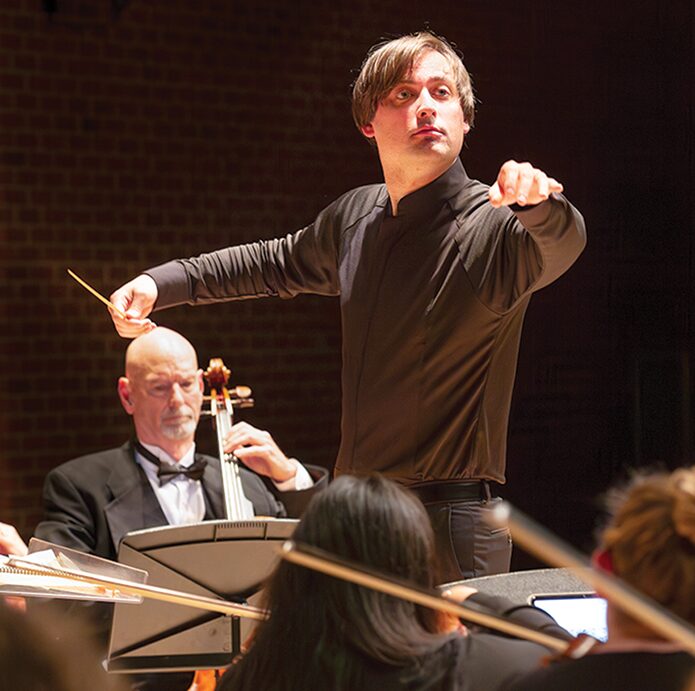
LANCASTER—The Northern Neck Orchestra will present a matinee concert Sunday, January 18, featuring the enchanting music of four outstanding American composers as it participates in the nationwide celebration of the 250th anniversary of the Declaration of Independence, “America 250.”
The program will include Amy Beach’s “Bal Masque,” Florence Price’s “Adoration,” Samuel Barber’s “Adagio for Strings” and “Knoxville: Summer of 1915,” with award-winning soprano soloist Alexandra Razskazoff, and Aaron Copland’s “Appalachian Spring.”
The concert will begin at 2 p.m. at the Lancaster Elementary School Theater, 191 School Street, Kilmarnock. A pre-concert talk will begin at 1:15 p.m. with music director Michael Repper. He will be joined at the talk by the Lancaster Elementary School Choir, under the direction of Destiny M. Carter, which will perform “Simple Gifts,” the 1848 Shaker song that appears in Copland’s “Appalachian Spring,” reported Bud Ward.
Admission is by season subscription, or $40. Purchase tickets at www.northernneckorchestra.org, or at the door. Students will be admitted free with an online reservation.
“I’m thrilled about this January concert,” said Repper. “Bringing these American composers together opens up a powerful narrative of expression and color. With Alexandra Razskazoff’s luminous soprano anchoring part of the evening, I know the energy in the room will be unforgettable.”
The performance will begin with pioneering pianist-composer Beach’s “Bal Masqué,” composed in 1893. Originally written for solo piano, the work was described by musicologist William E. Runyan as “a charming waltz in the best of the salon tradition.” Beach later arranged the piece for full orchestra.
Beach, who lived from 1867 to 1944, composed more than 150 works. Her “Gaelic Symphony,” composed in 1895, is considered the first published symphony by an American woman. Beach left a lasting legacy of support for future female artists through her co-founding of the Society of American Women Composers.
The orchestra next will perform African American composer Price’s “Adoration,” originally conceived for solo organ reflecting her early works as an organist accompanying silent films. One of the last compositions Price wrote before her death in 1953, “Adoration” has been called a lyrical repose of pure traditional musical beauty.
Composer of more than 300 pieces, Price is known to audiences of the NNO which has performed several of her works.
Barber’s “Adagio for Strings” is among the most celebrated American compositions. Composed in 1938, it debuted with one of the greatest names in the history of orchestral conducting—Arturo Toscanini, who gave the piece its world premiere in a nationwide NBC Symphony broadcast.
Written by Barber as part of his only string quartet, the “Adagio” has become widely associated with solemn occasions, including the funerals of Franklin Delano Roosevelt, Albert Einstein and Princess Grace of Monaco. Although only seven minutes in length, the work possesses an intense emotional impact that continues to move audiences deeply.
By contrast, Barber’s dreamlike “Knoxville: Summer of 1915” is filled with romance and nostalgia. The haunting beauty of this work will be amplified by Razskazoff. The soprano was a Grand Finals winner of the Metropolitan Opera’s Laffont Competition in 2022.
Composed by Barber in 1947, the work is a luminous homage to a simpler time in America as told through the recollection of a child. With text from a short prose poem by Knoxville native James Agee, the composer creates a picture of the writer’s hometown and family.
The concert will conclude with Copland’s “Appalachian Spring.” The work was commissioned as a ballet for choreographer Martha Graham. Originally scored for an ensemble of 13 instruments, it was later arranged for orchestra.
Set in 19th century Pennsylvania, the piece features variations of the Shaker song “Simple Gifts.” The Graham’s ballet “Appalachian Spring” premiered in 1944. Copland was awarded the Pulitzer Prize for Music in 1945.
With Graham’s “bare outline,” Copland later wrote, “I knew certain crucial things—that it had to do with the pioneer American spirit, with youth and spring, with optimism and hope.”