


Having spent almost 40 years writing about and taking folks fishing in the Chesapeake Bay and its tributaries, I’m still excited to kick off the beginning of each season.
Locally, May is regarded as the true “grand opening” of the fishing season. The winter doldrums have passed, flowers are blooming, and the middle Chesapeake Bay is teeming with life as migration cycles hit their stride.
Conditions are ripe for hot fishing with above average temperatures this spring. As we enter this month, our inland water temperatures have climbed steadily past 65 degrees and are pushing the upper 60’s in shallow waters of creeks and heads of small local rivers. This temperature is the “sweet spot” for metabolic activity; fish are hungry, aggressive, and moving into shallower haunts. I call it the transition from vertical migration up channels to the horizontal feeding on the flats and areas of structure.
Where are the Fish?
 Striped bass, or rockfish, arrived on the spawning grounds in the upper bay and rivers in late winter. They staged early and the good conditions encouraged a strong spawn. Higher salinity promotes better hatching and survival, which should result in a good recruitment year. A large portion of the breeding fish lingered up river after spawn prior to heading toward big water. The young schooling fish have remained deep in the rivers, while the large cows are in a strong retreat toward the ocean this month. You’ll find stragglers hugging the structure of the Potomac and Rappahannock channel edges as well as in the bay. The bite is strongest during the moving tide as they feed on bunker and baitfish swimming up the bay and river.
- Speckled trout and red drum are the stars of May, although Virginia has protected the trout this year by designating them as “catch and release only” until June 30. They are moving into the grass flats and marsh guts of the tributaries. The Eastern Shore, Tangier Sound and the western shore’s shallow flats and marshes are heating up. The lower Rappahannock River and its feeders are holding fair numbers of trout at this time.
- Redfish are slower to arrive but seem to be filling in recently. Topwater baits and soft plastics are both enticing bites. Vary your retrieves and colors to find the best combination.
- White Perch, the “silver nuggets” of the bay have finished their spawn and are moving back down into the lower reaches of the creeks. They’ll be stacked up around private piers and rip-rap jetties in the creeks and waterways of the mid and upper Potomac and Rappahannock rivers. Local creeks are also holding these fish.
- Bluefish usually make their first substantial appearance in the bay during mid-May. These are usually smaller “Taylor” size fish, but a few larger fish have already been caught during an early run into the bay.
 Striped bass, or rockfish, arrived on the spawning grounds in the upper bay and rivers in late winter. They staged early and the good conditions encouraged a strong spawn. Higher salinity promotes better hatching and survival, which should result in a good recruitment year. A large portion of the breeding fish lingered up river after spawn prior to heading toward big water. The young schooling fish have remained deep in the rivers, while the large cows are in a strong retreat toward the ocean this month. You’ll find stragglers hugging the structure of the Potomac and Rappahannock channel edges as well as in the bay. The bite is strongest during the moving tide as they feed on bunker and baitfish swimming up the bay and river.
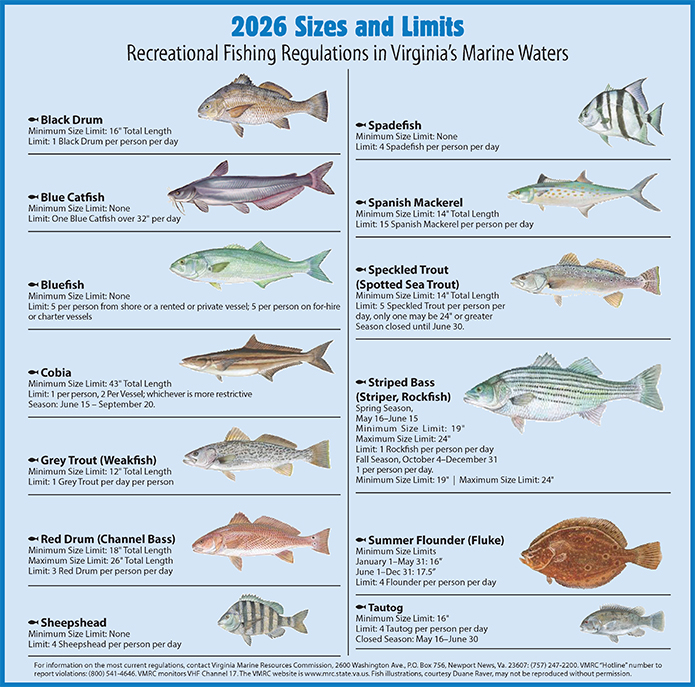
Click here for the updated 2026 Fish Sizes and Limits chart
Tip of the month
Follow the bait. In May, look for the “flicker” on the surface. Menhaden or bunkers, both juvenile and adult, have made a nice showing this spring. There are plenty of bay anchovies “glass minnows”, bull minnows and silvery minnows filling our creeks at this time. Water temperatures over 60 degrees throw baitfish into high gear.
In the shallows, sometimes a single tern or gull picking at the water will show where the food source is. Osprey prowling the shallow waters is also a good sign of life. If the birds are there, bait is there…and dinner is usually in close proximity.
The Bay is calling, and the table is being set. I’ll see you out on the water.
Until next time . . . fair winds